
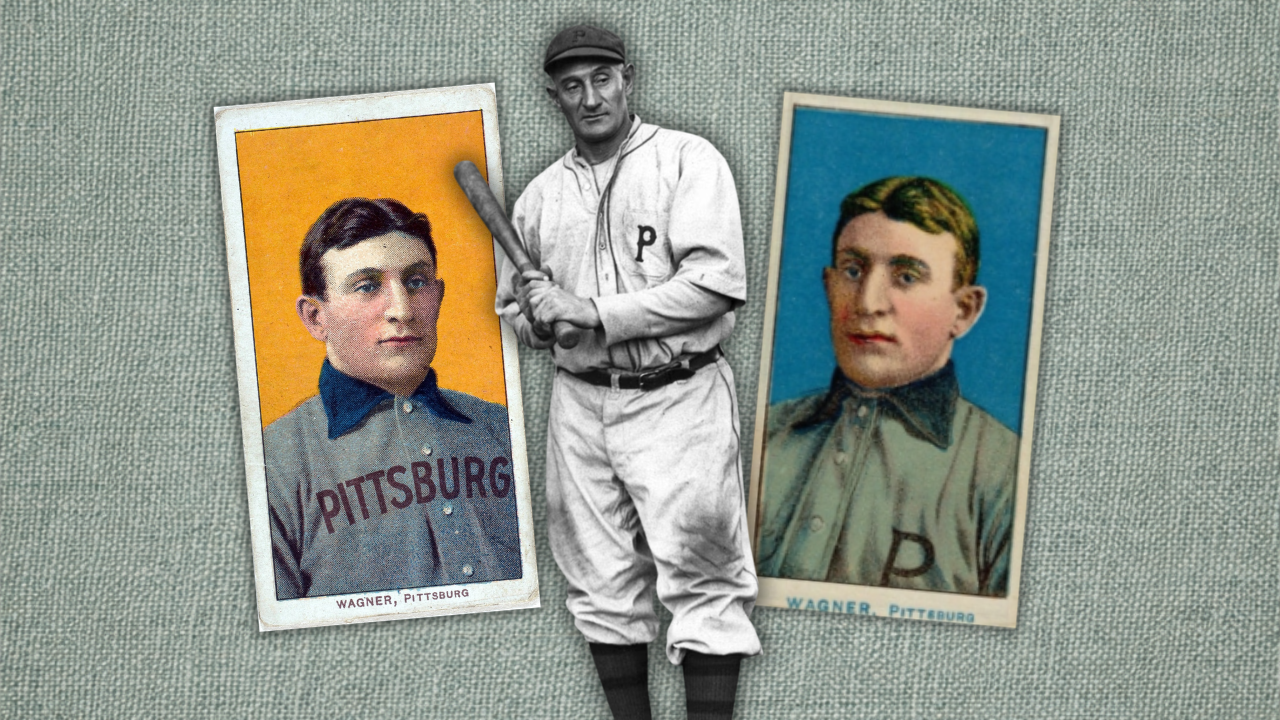
Honus Wagner dominated the National League in the early 1900s, winning a record eight batting titles and establishing himself as the era’s best all-around shortstop.
Wagner’s greatness on the field translated into some of the most important and valuable baseball cards ever produced.
This list brings together his most notable baseball card appearances, balancing historical importance, set significance, and long-term hobby value.
10 Great Honus Wagner Baseball Cards
10. 1948 Leaf Honus Wagner
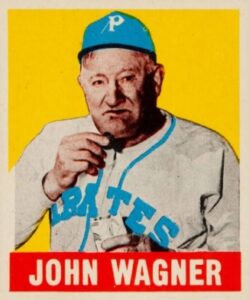
While most cards on this list date back to Wagner’s playing days, the 1948 Leaf Honus Wagner offers collectors something a bit different – It shows him long after his retirement, during his time as coach for the Pittsburgh Pirates.
The 1948 Leaf set is a timeless gem of a release, known for its bold colors, thick card stock, and frequent print issues, including off-centering and color registration problems.
The card itself is filled with oddities, from the Pirates’ light blue colors and an undersized cap to it being the only coach card in the set – Plus the bold decision to list him as “John Wagner” rather than Honus.
Although far more affordable than his early tobacco cards, the 1948 Leaf Wagner remains a highly desirable option for collectors looking to own a vintage Wagner card with strong historical significance.
9. 1910 E91 American Caramel Honus Wagner
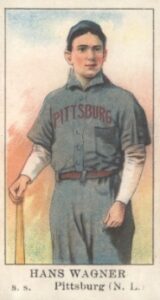
Wagner appears in Set C of the 1910 American Caramel issue, but the card is unusual for the wrong reasons.
The artwork does not actually depict Wagner, and the same image was reused for multiple players.
Despite this flaw, the card remains rare and historically important as one of Wagner’s early caramel issues. American Caramel would later redeem itself with far stronger Wagner designs.
8. 1910–1911 M116 Sporting Life Honus Wagner
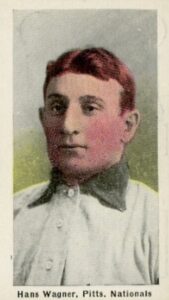
Sporting Life magazine issued this card through a mail-order promotion, offering subscribers 12-card series for just four cents.
Wagner’s card can be found with multiple back advertisements and two distinct front color styles, including a rare blue-tinted version.
This set reflects the growing role of sports publications in early baseball card distribution.
7. 1911 M110 Sporting Life Cabinets Honus Wagner
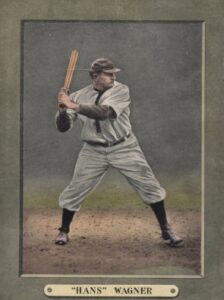
This oversized cabinet card is often considered one of Wagner’s most visually appealing issues. Produced in very limited numbers, the set includes only six players.
It’s among the rarest and best-looking striking Honus Wagner cards in existence. The example offered is bright and clean, featuring a sharp, well-defined image of Wagner at the plate.
6. 1914 (& 1915) E145 Cracker Jack Honus Wagner #68
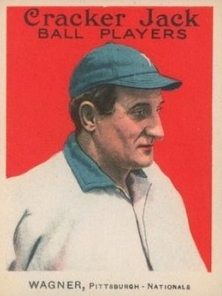
Wagner appears in both the 1914 and 1915 Cracker Jack sets, which feature nearly identical cards, but with subtle differences on the reverse. Both are #68 in the checklist.
Inserted directly into sticky boxes of caramel corn, the 1914 cards were battered by sugar and heat, making high-grade examples exceptionally rare today.
The easiest way to tell the two years apart is the 1915 version’s upside-down back text.
5. 1910 E93 Standard Caramel Honus Wagner
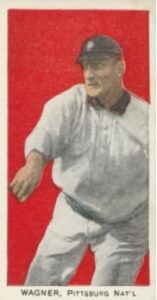
The E93 Standard Caramel set includes 30 cards packed with Hall of Fame talent. The cards use tinted photography to simulate color, with bold and vibrant backgrounds.
Wagner’s card highlights the simplicity of early uniforms, featuring little more than a “P” on his cap.
4. 1910 E90-2 American Caramel Pittsburgh Pirates Honus Wagner
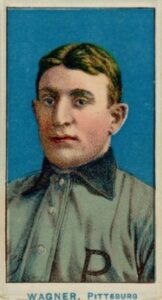
This 11-card team set celebrates the Pirates’ 1909 World Series championship. The city name appears as “Pittsburg” on the cards, reflecting the era’s spelling.
Wagner’s card features a deep blue background, while other players appear against different colors, giving the set a distinctive visual identity.
3. 1909–1910 E92 Dockman & Sons Honus Wagner (Throwing & Batting)
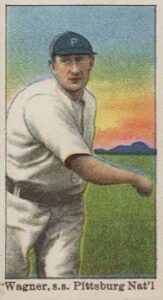
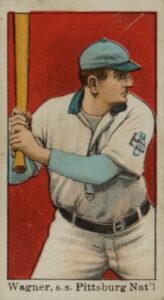
Wagner is one of only two players with multiple cards in the E92 Dockman & Sons set.
One card shows him batting against a red background, while the other depicts him throwing in a scenic setting.
Despite the drastically different designs, both versions carry similar value and are equally desirable to collectors, as some of his earliest cards.
2. 1903 E107 Breisch-Williams Honus Wagner
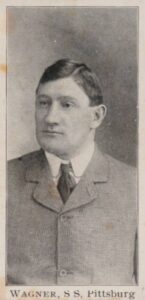
Wagner’s first true baseball card appears in the E107 Breisch-Williams set, a release that helped establish the standard size and design for future tobacco cards.
The card shows Wagner in a suit, reflecting early expectations of professionalism from athletes.
It’s one of his most valuable cards. No Mint or Near-Mint examples are known, but even heavily worn copies routinely sell for well over $50,000.
1. 1909–1911 T206 American Tobacco Company Honus Wagner
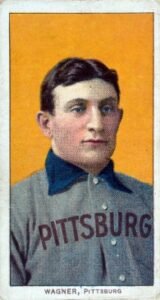
For anyone who knows anything about baseball cards, it’ll be no surprise to see arguably the most famous baseball card ever produced take the top spot.
Unusual circumstances led to the card being pulled from circulation very soon after its initial release, which makes it an incredibly rare card today – Only around 50 in existence today.
Although it was printed, production was halted, and only a small number escaped circulation.
Today, the T206 Honus Wagner is a mythical grail that few collectors will ever get to hold in person, nevermind own.
It’ll always remain one of the most valuable sports cards of all time.
Honus Wagner: A Background
Wagner began his career with the Louisville Colonels, but after the National League contracted following the 1899 season, his contract was purchased by the Pittsburgh Pirates. From there, his legend grew quickly. In 1900, he hit .381, led the league in doubles, triples, and slugging percentage, and soon became the face of the Pirates.
He led Pittsburgh to the first World Series in 1903 and later won a championship in 1909 by defeating Ty Cobb and the Detroit Tigers. Wagner was also a pioneer off the field, becoming the first known player to autograph a bat for Louisville Slugger – Often cited as one of the earliest athlete endorsement deals.
Inducted into the inaugural Hall of Fame class in 1936, Wagner remained part of the game for decades, serving as a Pirates coach until 1951. While many of his earliest cards are far beyond the reach of most collectors, later issues from the 1940s and 1950s offer more accessible ways to own a piece of his legacy.